
Between Warsaw and Gwangju: The Poland Pavilion at Gwangju Biennale 2026 explores transition, continuity, and community
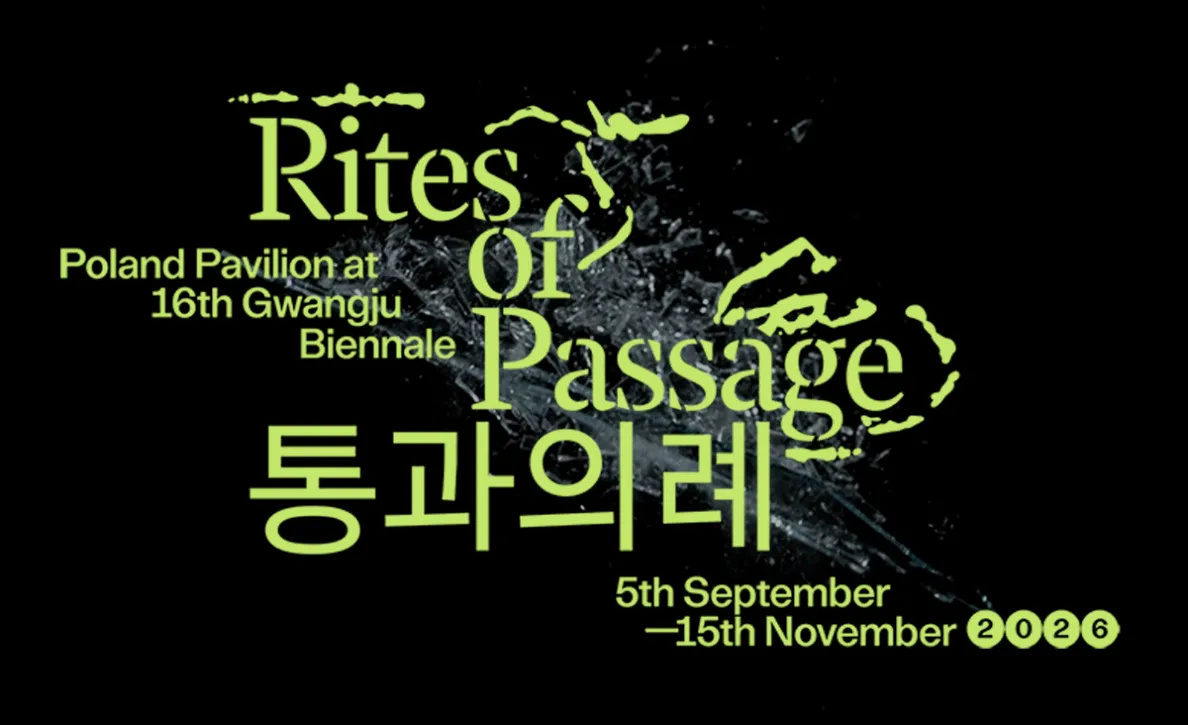
What happens when one chapter of life has come to an end, but the next has yet to begin? Rites of Passage, an exhibition organised by the Adam Mickiewicz Institute for the Poland Pavilion at Gwangju Biennale 2026, explores the experience of transition – both on a personal and a global scale. The project takes its point of departure from The White Book by Han Kang, the Nobel Prize-winning Korean author born in Gwangju, who lived in Warsaw while writing the book.
The exhibition is curated by Paulina Olszewska and brings together artists from Poland and Korea: Alicja Bielawska, Urszula Broll, Inside Job (Ula Lucińska and Michał Knychaus), Park Saengkwang, Yeesookyung, and Anna Zaradny. Rites of Passage will be presented as part of the 16th Gwangju Biennale, held this year under the theme You Must Change Your Life. One of the most important contemporary art events in Asia, the Biennale will run from 5 September to 15 November 2026.
A Time of Profound Transformation
We live in a time of constant flux, yet we increasingly lack shared rituals that help us navigate through it. What was once embedded in the rhythm of communal life – transitions between life stages, mourning, coming of age, the beginning of a new chapter – has often become a private experience, difficult to articulate. It is precisely this condition that Rites of Passage, presented in the Poland Pavilion at Gwangju Biennale, seeks to explore.
Each of us experiences moments when we must leave behind what is familiar and secure and step into the unknown. Today, this experience also has a collective dimension: we are living through wars, crises, and profound transformations that reshape our sense of security. At the same time, in a world marked by individualism and the erosion of social bonds, we increasingly lack shared rites of passage. The Poland Pavilion at Gwangju Biennale is not only an opportunity to present Polish art on one of Asia's most important artistic stages, but also to participate in a wider conversation about how we can face change together and rebuild a sense of community – says Olga Wysocka, Director of the Adam Mickiewicz Institute.
Han Kang between Gwangju and Warsaw
The exhibition takes as its starting point a passage from The White Book, written by Han Kang during her stay in Warsaw in 2016. In it, the author reflects on a moment of hesitation: the threshold between what has already happened and what is yet to come. It is a moment of uncertainty, anticipation, and stepping into the unknown.
“We stand on this sharp edge of time – the transparent cliff that constantly renews itself – and move forward. Uneasily we place one foot on the edge of the time we have lived through so far, while the other stretches without hesitation into the void, without even a fraction of a second in which to summon our own will. It is not exceptional courage that drives us; there is simply no other way. I realise the risk of this now, at this very moment. Recklessly I step into time I have not yet lived, into the space of a book I have not yet written.” – Han Kang, The White Book (2016), translated by Deborah Smith.
Why Do We Need Rites of Passage Today?
For curator Paulina Olszewska, this image became the starting point for a broader reflection on rites of passage – those moments when our lives change, sometimes dramatically, sometimes almost imperceptibly. From birth to death, from personal decisions to historical turning points, change is a constant presence. It shapes our everyday lives, memory, relationships, and communities.
Transformation often evokes anxiety because it entails the loss of what is familiar. Yet it is precisely in moments of transition that the possibility of imagining something new emerges. In a world where change affects not only individuals but entire societies, systems, and communities, rites of passage acquire renewed relevance. Rites of Passage invites visitors to experience this ambivalence – between fear and potential, dissolution and the emergence of a new order – says Paulina Olszewska, curator of the exhibition.
An Exhibition to Be Experienced
The rite of passage is not merely the subject of the exhibition – it is also embedded in its spatial design. Visitors will move through a sequence of environments, ranging from spaces of subtle, almost imperceptible transformation to areas defined by distinct thresholds, tensions, and ruptures.
In one section, the artworks will gently merge into one another, suggesting change as a gradual process. In another, visitors will encounter contrast, dissonance, and a sense of disruption. The journey through the pavilion becomes a physical experience of crossing a threshold – of moving from one state of being to another.
The exhibition also responds to the theme of the 16th Gwangju Biennale, You Must Change Your Life. In a world marked by war, the climate crisis, social tensions, and increasing polarisation, transformation is no abstract concept. It is something we experience every day – in our private lives, in politics, in society, and in our relationships with others.
A Meeting of Artists from Poland and Korea
The exhibition brings together different generations, artistic traditions, and media. Traditional painting and drawing meet installation, video, sound, ceramics, textiles, and objects made from both organic and industrial materials.
Works by Alicja Bielawska, Inside Job, and Anna Zaradny are presented in dialogue with historical works by Urszula Broll and Park Saengkwang – widely regarded as one of the leading figures of modern Korean art, whose work has become an enduring part of Korea’s cultural heritage—as well as an installation by Yeesookyung. Together, they create a multisensory environment in which materials, images, sounds, and textures evoke an atmosphere of contemplation, suspension, and transformation.
A specially commissioned sound composition will form an integral part of the exhibition. Rooted in the traditional music of the region while incorporating experimental approaches to sound, it will serve as an acoustic guide through the exhibition – a sonic landscape accompanying visitors as they move through the successive spaces of the pavilion.
A Multisensory Space
Rites of Passage has been conceived as an open exhibition, without providing a single prescribed narrative or any straightforward answers. Each visitor is invited to experience it in their own way, interpreting its symbols, tensions, and transitions through the lens of their own sensibility.
It is a space for contemplation: intimate and personal, yet deeply attentive to the contemporary world. Viewed through both Polish and Korean perspectives, the exhibition becomes a shared meditation on change – inevitable, unsettling, yet profoundly human.
Poland at Gwangju Biennale
Founded in 1995, Gwangju Biennale is the oldest contemporary art biennial in Asia and one of the region’s most significant international art events. Its history is closely connected to Gwangju’s democratic legacy and the memory of the 1980 pro-democracy movement.
Since 2018, the Biennale has developed its Pavilion Programme, enabling cultural institutions and arts organisations from around the world to present their own exhibitions and public programmes. Poland joined in 2023 with its first Poland Pavilion – a three-day programme of performances and video screenings curated by Sebastian Cichocki and Marianna Dobkowska. In 2024, the Adam Mickiewicz Institute, in collaboration with WRO Art Center, presented Katastematic Pleasures, curated by Paweł Janicki, which was recognised as one of the most compelling presentations of the 15th Gwangju Biennale. In 2026, Poland will be represented by Rites of Passage, curated by Paulina Olszewska. The Artistic Director of Gwangju Biennale 2026 is Ho Tzu Nyen, the Singaporean visual artist, filmmaker, and performer whose practice explores history, memory, mythology, and the identities of Southeast Asia through film, installation, performance, and multimedia. His work has been presented at major international exhibitions, including the Venice Biennale, where he represented Singapore at the 54th International Art Exhibition in 2011.
Public Programme
The exhibition will be accompanied by a curator-led tour with participating artists in English, as well as a performance by Anna Zaradny.
"Rites of Passage" - Practical Information
-
Title: Rites of Passage
-
Event: Poland Pavilion at Gwangju Biennale 2026
-
Location: Gwangju, South Korea
-
Dates: 5 September – 15 November 2026
-
Curator: Paulina Olszewska
-
Artists: Alicja Bielawska, Urszula Broll, Inside Job (Ula Lucińska & Michał Knychaus), Park Saengkwang, Yeesookyung, Anna Zaradny
-
Organiser: Adam Mickiewicz Institute
-
Partners: Embassy of the Republic of Poland in Seoul, ING Polish Art Foundation, leeleenam studio, Galeria Studio
-
Project funded by the Ministry of Culture and National Heritage