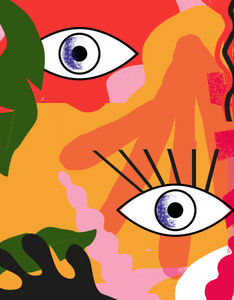

Aleksandra Waliszewska's Exhibition in Athens: Dark Paintings Among the Treasures of Antiquity
On 3 June 2026, the Benaki Museum in Athens opens the exhibition ‘Aleksandra Waliszewska: Irruption of Antiquity’. The Benaki Museum of Greek Culture sets the stage for one of Poland’s most important contemporary artists. Waliszewska’s dark and atmospheric paintings are presented in direct dialogue with a collection spanning works from the Greek Neolithic period to the modern era. By placing Waliszewska’s dark, symbol-laden paintings alongside the legacy of antiquity, the exhibition reveals how ancient myths, figures, and imagery continue to resurface in contemporary visual culture.The exhibition is open to visitors until 27 September 2026.
The irruption of Greek tradition into contemporary art
Aleksandra Waliszewska’s exhibition comprises sixteen paintings which will be displayed across two floors of the Benaki Museum, situating the Polish artist’s works right alongside the Athenian museum’s collections, and in turn creating a direct dialogue with artworks from the Greek Neolithic, Classical, Byzantine and Modern periods. Visitors will encounter moments where ancient motifs and visual tropes seem to ‘irrupt’ into Waliszewska’s intense, psychologically unsettling paintings.
The tension created by this juxtaposition offers a chance to trace lines of influence and inspiration reaching back to the very origins of Western visual culture. The exhibition is both a tribute to Greece as the birthplace of figurative and narrative art, and a reflection on how deeply its legacy continues to resonate in contemporary artistic practice.
The exhibition’s curator, Alison M. Gingeras, draws on Aby Warburg’s transhistorical approach; in his unfinished ‘Mnemosyne Atlas’, Warburg sought to create a visual map of collective cultural memory by tracing motifs that have remained constant in art throughout the ages.
A similar dynamic is at work in Aleksandra Waliszewska’s art. Ancient gods, myths, symbols, and religious figures appear in her paintings not as remnants of a distant past, but as vivid and unsettling presences that continue to haunt the contemporary imagination. In this sense, “Irruption of Antiquity” invites us to view antiquity not as a fixed and completed legacy, but as a living reservoir of images, emotions, and meanings that constantly return and take on new forms.
The exhibition was organised by the DESTE Foundation in collaboration with the Benaki Museum and with the support of the Adam Mickiewicz Institute.
The intriguing visual language of Aleksandra Waliszewska
Aleksandra Waliszewska, one of the most recognisable artists on the Polish cultural scene, is known for her dark, atmospheric paintings steeped in historical and artistic erudition. Waliszewska, a graduate of the Academy of Fine Arts in Warsaw, considers herself a contemporary heir to the Symbolist movement of the late 19th and early 20th centuries. Her paintings are dominated by strong female protagonists, often depicting apocalyptic scenes inhabited by animals, imaginary creatures, zombies, hybrid monsters and the living dead. Often allegorical in nature, her paintings explore the human condition, grappling with primal emotions such as fear, anxiety, desire and death. Waliszewska also draws on the canon of European art: from the primitive Flemish masters Petrus Christus and Georges de La Tour to the painters of Young Poland, and from the Belgian Symbolist Léon Spilliaert to Leonor Fini.
Aleksandra Waliszewska’s symbolic visual language and her fantastical visual world were also explored during the exhibition ‘The Dark Arts’, shown at the Museum of Modern Art in Warsaw (MSN) and at the M. K. Čiurlionis National Museum of Art in Kaunas. Both exhibitions were curated by Alison M. Gingeras, who serves as a curator at the MSN.
The exhibition organisers
The Benaki Museum is among the most extensive and innovative museum organisations in Europe. It was founded by Antonis Benakis in 1930 and subsequently donated to the Greek state. Arranged across a satellite network of six museum buildings, the museum also features five archival departments and an extensive library, the Leigh Fermor House, offering residencies to scholars, and a collection currently holding a 500,000-strong inventory covering all periods of Greek culture as well as European, Islamic, Pre-Columbian, African and Chinese art.
The DESTE Foundation for Contemporary Art is a non-profit institution established in Geneva in 1983 by collector Dakis Joannou. DESTE engages in an extensive exhibition program that promotes emerging as well as established artists and aims to broaden the audience for contemporary art, enhance opportunities for young artists, and explore the connections between contemporary art and culture. The flexibility of DESTE’s exhibition schedule enables the foundation to respond to what is trends in the art world, both nationally and internationally, and to embark on interesting projects as they emerge in contemporary society.
Aleksandra Waliszewska: Irruption of Antiquity
- Location: Benaki Museum, Koumpari 1, Athens 106 74, Greece
- Opening Reception: 2 June 2026, 8:00 PM
- Exhibition Dates: 3 June – 27 September 2026
- Curator: Alison M. Gingeras
- Artist: Aleksandra Waliszewska
- Organizers: Benaki Museum, DESTE Foundation for Contemporary Art
- Partner: Adam Mickiewicz Institute
- More information: benaki.org
Media contact:
Malwina Malinowska
e-mail: [email protected]
The Adam Mickiewicz Institute (IAM) brings Polish culture to people around the world. Being a state institution, it creates lasting interest in Polish culture and art through strengthening the presence of Polish artists on the global stage. It initiates innovative projects, supports international cooperation and cultural exchanges. It promotes the work of both established and promising artists, showing the diversity and richness of our culture. The Adam Mickiewicz Institute is also responsible for the Culture.pl website, a comprehensive source of knowledge about Polish culture. More information: https://iam.pl/en