
"Liquid Tongues" project in the Polish Pavilion for Venice Biennale 2026
“Liquid Tongues” is the title of a project that will be presented at the Polish Pavilion at the 61st International Art Exhibition of La Biennale di Venezia in 2026. The installation invites the audience to move beyond familiar modes of perception and to engage in deep listening to marginalized languages, Deaf culture, and more-than-human forms of communication. The project will be on view from 9 May to 22 November 2026. The producer of the exhibition is Zachęta – National Gallery of Art, and the partner presenting the Polish installation in Italy is the Adam Mickiewicz Institute.
Artistic concept of the project „Liquid Tongues”– an installation exploring alternative forms of communication
The project “Liquid Tongues” submitted by curators Ewa Chomicka and Jolanta Woszczenko, was selected for the Polish Pavilion at the 61st International Art Exhibition in Venice through a two-stage open competition conducted by a jury of experts in the fields of art and architecture. The audio-video installation representing Poland was created by Bogna Burska and Daniel Kotowski. The project involves Chór w Ruchu (Choir in Motion) – a group composed of hearing and Deaf participants – who interpret communication codes and whale songs in both spoken language (English) and International Sign (IS). The project explores alternative ways of communicating, inspired by more-than-human forms of life.
The narrative axis is formed by stories of loss and renewal – from the revival of whale cultures to contemporary efforts to reclaim languages and narratives marginalized by dominant communication systems. An important reference point for the project is Roger Payne’s 1970 recordings “Songs of the Humpback Whale,” which contributed to the introduction of the ban on whaling and played a significant role in the whales’ preservation. The complex sounds of whales drew global attention to the intelligence and richness of animal cultures, demonstrating that art can restore audibility to voices previously overlooked.
The installation “Liquid Tongues” operates on multiple levels: image (photographs by Magda Mosiewicz and Bogna Burska), sound (composition by Aleksandra Gryka), and physical experience, generated by acoustic waves corresponding to sensations evoked by cetacean vocalizations and echolocation. The choreography of the Choir’s collective body is inspired by the movement of fish shoals (Alicja Czyczel).
“In Minor Keys” – the guiding concept of the Venice Art Biennale 2026
The title of the 2026 Venice Art Biennale, curated by Koyo Kouoh – “In Minor Keys” – proposes a different way of perceiving and listening to the world. The metaphor of minor keys refers not only to specific musical moods, but above all to subtle, quiet, and less obvious frequencies of life that are often lost in the noise of contemporary reality. The Biennale’s concept invites contemplative encounters with what is fragile and usually overlooked – softer voices, neglected narratives, and micro-memories. It encourages the development of subtle forms of resistance, the creation of new relationships and sensitive experiments, as well as the building of polyphonic societies based on mutual listening, sensing, and resonance.
„Liquid Tongues” develops this idea by attempting to transcend imagined boundaries of communication and to create communities of subjects that take into account diverse perspectives – including the animal perspective.
The Biennale points to the sounds and stories of individuals and communities who, despite experiences of loss, create beauty, rebuild worlds, repair relationships, and form new modes of togetherness. It proposes slowing down, attuning to subtle emotions and moods, and recognizing “small islands” of intense life operating within larger political and ecological systems. The exhibition presents artists’ worlds as collective, polyphonic spaces in which art intertwines with everyday experience and emotional sensitivity, offering audiences an experience that is more sensory than didactic – one that fosters reflection, attentiveness, and the shared experience of hope for transformation in the face of contemporary crises.
Authors and project team of “Liquid Tongues”
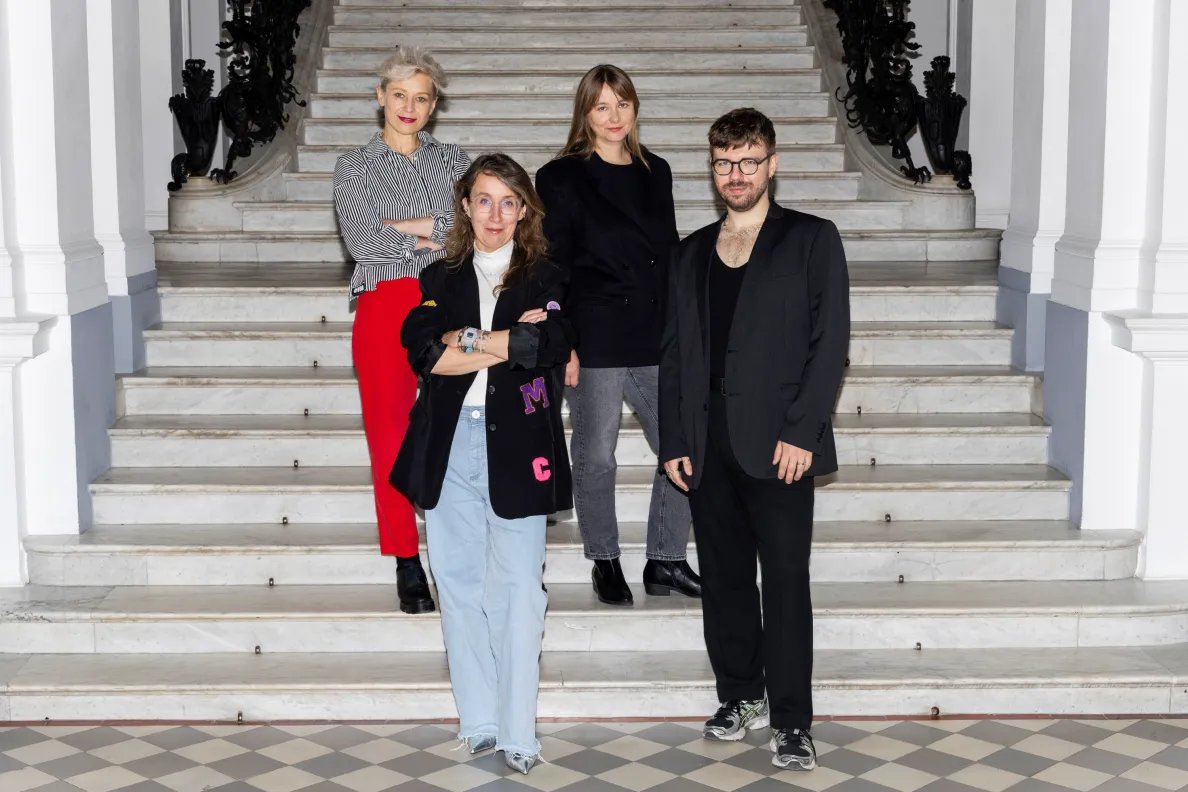
The authors of the project “Liquid Tongues” are Bogna Burska and Daniel Kotowski. Bogna Burska is an acclaimed Polish visual artist and playwright whose works have been presented at major art institutions in Poland and internationally. Daniel Kotowski is an artist and performer known for innovative research into Deaf experience and language, carried out in an international context. The project is curated by Ewa Chomicka and Jolanta Woszczenko. Contributors include Chór w Ruchu, Alicja Czyczel, Aleksandra Gryka, and Magda Mosiewicz. The producer of the project is Zachęta – National Gallery of Art, the institution responsible for the Polish Pavilion at the Venice Biennale. The Adam Mickiewicz Institute is the partner of the project.