
Polish Pavilion at the Malta Biennale 2026 Opens on 11 March with Weronika Zalewska’s “Archive of Hesitations”
On March 11, the Polish Pavilion will open in Valletta as part of the second edition of Malta Biennale. Poland will be represented by Weronika Zalewska’s project Archive of Hesitations – a video installation curated by Ada Piekarska. The project examines how knowledge, memory, and political imagination are shaped in an era of continuous 24/7 information flow. The exhibition will run until May 29, 2026.
The Polish Pavilion at Malta Biennale 2026 is organized by the Adam Mickiewicz Institute in collaboration with Galeria Bielska BWA, the Embassy of the Republic of Poland in Valletta, and the City of Bielsko-Biała – Polish Capital of Culture 2026.
Maurizio Cattelan as a headliner of this year’s Malta Biennale
Malta Biennale is one of Europe’s youngest and fastest-growing contemporary art events. The second edition will feature over 130 artists from around the world, including eight national pavilions and 21 thematic pavilions. This year’s edition is held under the artistic direction of renowned curator Rosa Martínez. The headlining artist of the 2026 edition will be Maurizio Cattelan. Malta Biennale 2026 will open to the public on March 14, following a three-day preview (March 11-13) and the official inauguration on March 10. The programme will also feature an extensive educational programme and a range of accompanying events.
This is the first edition in which the Adam Mickiewicz Institute oversees the Polish national pavilion at Malta Biennale.
By entrusting the Polish Pavilion to a younger generation, we are opening space for new perspectives. The Malta Biennale creates a platform for artistic dialogue on the shape of our shared reality – extending beyond culture into the wider social sphere. Together with Galeria Bielska BWA and the City of Bielsko-Biała – Polish Capital of Culture 2026, we are building a strong and visible Polish presence in the international art circuit, says Olga Wysocka, Director of the Adam Mickiewicz Institute.
In a world of instant answers, hesitation becomes a gesture of resistance
Weronika Zalewska’s video installation, presented in the Polish Pavilion, explores how knowledge, memory, and political imagination are formed in an era of continuous 24/7 information flow.
The project was inspired by the artist’s childhood memories of watching television with her grandmother in the early 2000s, at a time when her first institutions about the socio-political were beginning to take shape. The grandmother’s lived experiences remained mostly unspoken – fragmentary, intimate, difficult to translate – while television delivered a steady flow of ready-made narratives shaped by the logic of the 24-hour news cycle and alluring entertainment culture.
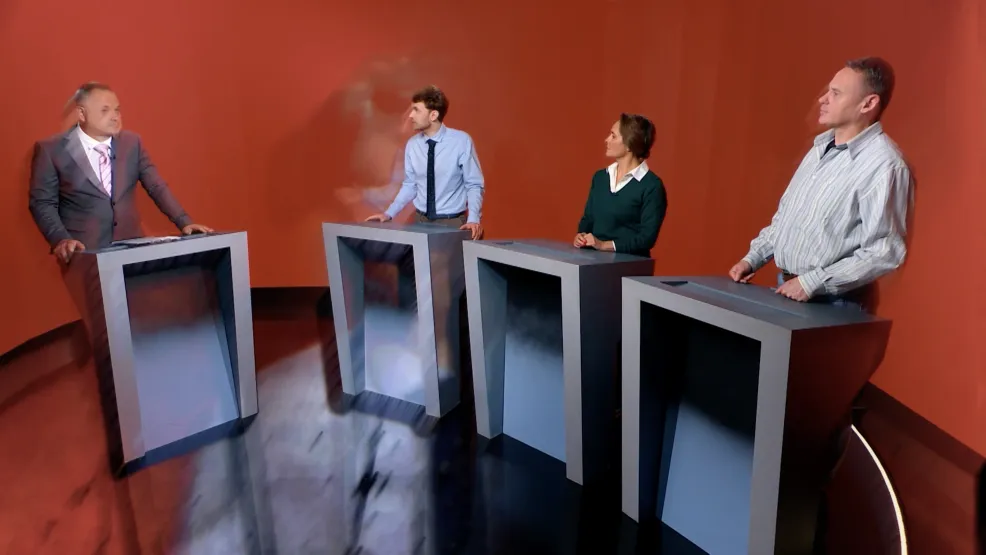
The installation consists of two parallel projections. The first stages a fictional TV quiz show titled Everything Is Clear, featuring a mechanic, a librarian, and a young entrepreneur – a cross-section of Polish society during the period of post-communist transformation. The programme is conducted in English, a language the participants do not fully master. This is a deliberate strategy: within a system based on instant verification and a single “correct” answer, cracks begin to appear. As the rules constantly change and certainty weakens, hesitation starts to undermine the authority of the “correct” response.
The second channel presents a non-linear montage of archival materials from the Polish WFO Film Studio. Scenes of everyday life, small gestures, and object details create a calm, repetitive rhythm – in stark contrast to the pace of the quiz show. Animations based on a feedback loop by visual artist Mila Nowacka, reveal the materiality of the image itself and introduce elements of visual disruption.
By juxtaposing these two regimes – the procedural logic of the quiz show and the relational, fragmented archive – the installation exposes the tension between measurable knowledge and lived experience. In today’s world saturated with data and instant opinions, Archive of Hesitations proposes something rare: a pause. Here, hesitation is not a sign of weakness but a conscious gesture of resistance and responsibility.
Polish Presence at Malta Biennale 2026
A strong Polish presence will be visible at Malta Biennale as in 2026, the OmenaArt Foundation returns to the Malta Biennale, with a thematic pavilion titled Redefining. Polish-Ghanaian Textile Narratives. The exhibition, curated by Natalia Bradbury, will feature large-scale textile installations created by Marta Nadolle, Eliza Proszczuk, and Ernestina Mansa Doku during an artistic residency in Malta. The artists, from Poland and Ghana, will interweave the historical narratives of both countries, drawing on weaving traditions and the island’s local heritage.
Weronika Zalewska is an artist, researcher, and poet. She creates video works at the intersection of documentary and speculative fiction, engaging with themes such as socio-economic transformations and their impact on the production of narratives and relations. Her works have been exhibited, among others, at Zachęta-National Gallery of Art, BWA Wrocław, Galeria Bielska BWA and the Performance Biennial in Vilnius.
Ada Piekarska is a curator and writer on contemporary art. She currently heads the programming team at Galeria Bielska BWA in Bielsko-Biała, Poland. Her curatorial practice focuses on the non-artistic functions of contemporary art, particularly its entanglements with structures of power and its capacity to reshape social imaginaries. She is the curator of the Bielska Jesień Painting Biennale – one of the most important art competitions in Poland.
Archive of Hesitations
Polish Pavilion at Malta Biennale 2026
March 11 – May 29, 2026
-
Press preview: March 11-13
-
Opening to the public: March 14
-
Curator: Ada Piekarska
-
Artist: Weronika Zalewska
-
Animation: Mila Nowacka
-
Sound: Szymon Gąsiorek
-
Graphic design: Renata Motyka
-
Organizer: Adam Mickiewicz Institute
-
Co-organizer: Galeria Bielska BWA
-
Partners: Embassy of the Republic of Poland in Valletta, City of Bielsko-Biała – Polish Capital of Culture 2026, TVP Kultura, WFO Film Studio
The project is co-financed by the Ministry of Culture and National Heritage of the Republic of Poland and the City of Bielsko-Biała – Polish Capital of Culture 2026.
Media contact:
Klaudia Gniady
Phone: +48 609 092 949
e-mail: [email protected]
The Adam Mickiewicz Institute (IAM) brings Polish culture to people around the world. Being a state institution, it creates lasting interest in Polish culture and art through strengthening the presence of Polish artists on the global stage. It initiates innovative projects, supports international cooperation and cultural exchanges. It promotes the work of both established and promising artists, showing the diversity and richness of our culture. The Adam Mickiewicz Institute is also responsible for the Culture.pl website, which is a comprehensive source of knowledge about Polish culture. More information: iam.pl.